
Alkane characteristics
- What an alkane looks like at room temperature depends upon its size.

- Alkanes contain non-polar molecules and mix well with each other; however they do not mix well with non-polar substances such as water.
- Alkanes are unreactive towards many laboratory reagents; they are unaffected by acids, alkalis, metals and oxidising agents.
- When they do react, it is usually in the gas phase, and energy is needed to get the reaction started.
Melting and Boiling points of Alkanes
- As the molecular number increases, the boiling and melting point of the alkane increases.
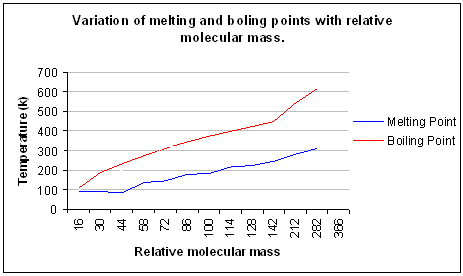
- C1 to C4 are gases, C5 to C17 are liquids, C18 and higher are solids.
- The increase in the boiling point is due to the stronger intermolecular forces.
- In hydrocarbons the only intermolecular forces are instantaneous dipole, induced dipole interactions.
- In a molecule, electrons are mobile, and at one point they may all find themselves at one end of the molecule. This will form a temporary dipole, affecting neighbouring molecules, pulling the molecules together.
- At the next instant the electrons could end up at the other side reversing the polarity of the molecule.
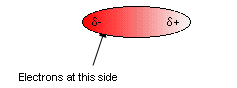
- This permanent moving around of the electrons causes rapidly fluctuating dipoles which hold together the hydrocarbons.
- The higher the molecular weight of the compound, the more electrons there are in the molecules, meaning the stronger these Van der Waahl forces. This is why the melting points and boiling points of the larger molecules are higher.
- Branched alkanes have a lower Van der Waahl force than chains, due to their shape, which doesn’t allow the molecules get close enough to each other.
Oxidation of Alkanes
- Alkanes do not react readily with air, but if they are heated they can combust to form carbon dioxide and water.
- The reaction has a high activation energy; the energy must be supplied in order for the reaction to begin.
- Alkanes must be vaporised before they can combust, thus more volatile hydrocarbons ignite easier.
- Once ignited, the reaction is very exothermic, which is why alkanes are often used for fuels.
- If the air supply is limited, the combustion may be incomplete, producing carbon dioxide and soot, along with partially combusted hydrocarbons.
Useful books for revision:
Revise AS Chemistry for Salters (Written by experienced examiners and teachers of Salter's chemistry)
Revise AS Chemistry for Salters (OCR) (Salters Advanced Chemistry)
Home